
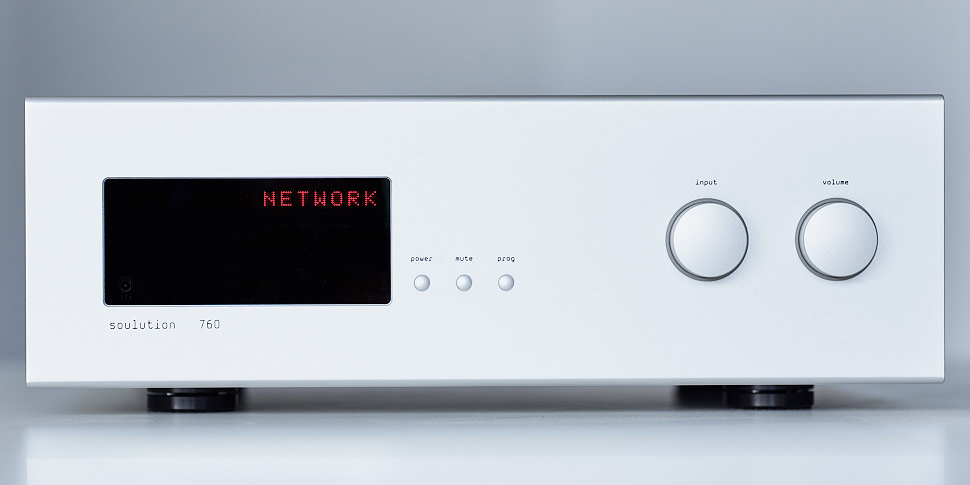
Soulution 760
Dane techniczne
Zasilanie 220 – 240 V (50 – 60 Hz); 100 – 120 V (50 – 60 Hz)
Pobór mocy < 0,5 W w trybie czuwania, 60 W podczas pracy urządzenia
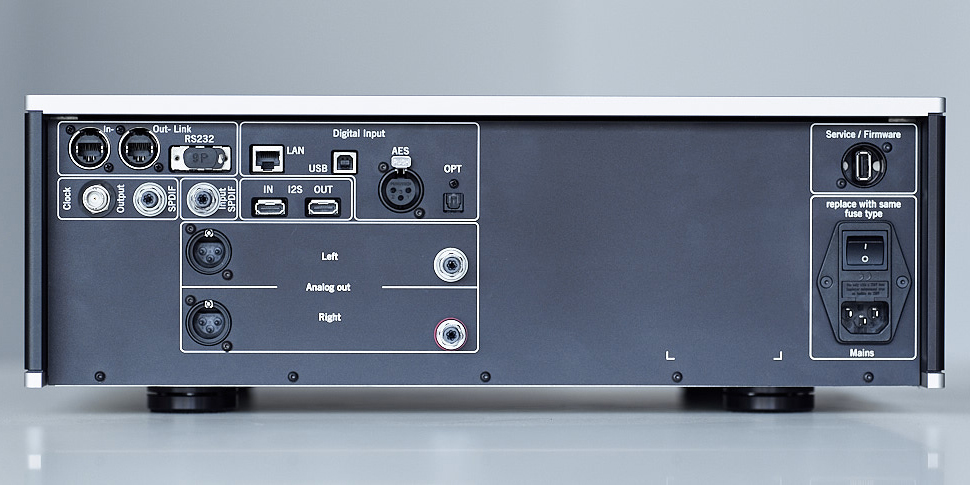
Wyjścia analogowe 1 × symetryczne (XLR); 1 × niesymetryczne (RCA)
Pasmo przenoszenia 0 – 200 kHz (DXD)
THD+N < 0,0005% (20 Hz – 20 kHz)
Stosunek sygnału do szumu > 140 dB
Separacja kanałów > 130 dB
Impedancja wyjściowa 2 Ω zbalansowana (XLR); 2 Ω niezbalansowana (RCA)
Napięcie wyjściowe 4 VRMS zbalansowane (XLR); 2 VRMS niezbalansowane (RCA)
Prąd wyjściowy maks. 1 A (ograniczony przez obwód zabezpieczający)
Gama regulacji głośności 0 do – 79 dB w krokach co 1 dB
Wejścia cyfrowe AES/EBU, SPDIF-RCA, optyczne, USB, sieć
Wyjścia cyfrowe AES/EBU, SPDIF-RCA, zegar BNC
Formaty cyfrowe WAV, AIFF, FLAC, ALAC, DSF, DFF, DXD, MP3, AAC
Głębokość bitowa/częstotliwość próbkowania (maks.) AES/EBU: 24 bit/192 kHz; SPDIF: 24 bit/192 kHz; Optyczne: 24 bit/ 96 kHz, 24 bit/384 kHz; USB: 1 bit/5.64 MHz, 24 bit/384 kHz; Network: 1 bit/5.64 MHz
Wymiary (szer. x wys. x gł.) 480 × 167 × 450 mm
Waga ok 30 kg
LINK (zdalne włączanie) Sygnał sterujący 12 V
Soulution 760
Recenzje
Recenzja Soulution 760 w The Absolute Sound
If you listen only—or primarily—to ones and zeroes, I would be hard put to recommend anything, regardless of price, over the Soulution 760. It just offers so much more of what I like and expect to hear from the best recorded music. Here, finally, is the whole package—air, bloom, space, dimensionality, dynamic scale, electrifying transient response (on electrifying transients), fabulous low end, and (for once) equally fabulous treble—and you get all this with the digital compromises stripped away, which (for me) raises the pleasure quotient a thousand-fold.
What more can I tell you? As of this writing, the Soulution 760 is (by a considerable margin) the most musical DAC I’ve ever heard.
I started this review by telling you that the Soulution 760 was different than any other DAC I’ve listened to—and that it was different in an entirely positive way. Although I’m tempted to use the well-worn phrase “more analog-like” to describe that difference, the fact is this DAC is quite a bit more specifically “analog-like” than those oft-used-and-abused words generally imply. What the Soulution 760 sounds (uncannily) like—to put a precise point on it—is Greg Beron’s superb Ultima4 OPS-DC 15ips reel-to-reel tape deck, minus the tape hiss and slight overall darkness of timbre. Not only has it rid itself of the usual digital nastiness in the upper midrange and treble, it has also managed to eliminate the vestigial brightness that you so often hear in LP playback, particularly with zippier moving coils. Indeed, given the right recording I have never heard a DAC (and only a few select record players and cartridges) that is as neutral and natural in the upper midrange and treble as the Soulution 760.
I was literally shocked, for example, to hear the delicacy with which Levon Helm—whom Al Kooper once called “a giant iron metronome”—played ride and hi-hat on certain cuts from The Band’s Rock of Ages (see below for a good deal more on this recording). It was the first—maybe the only—time I was confidently able to gauge via a digital source not just how strongly but also how softly a drummer was striking his cymbals (and in Helm’s case the wooden rims of his snares).
Touch and timing are two of the ways we judge a performer’s artistry. They are how, for instance, I learned to appreciate Van Cliburn’s performance of the Prokofiev Third Piano Concerto—a rendition I hadn’t much cottoned to before I heard it through the Børresen 05 loudspeaker and the Soulution 760 DAC (Issue 309), and recognized (indeed, could almost see) the artful and moving way Cliburn was sounding those wintry falling thirds in the famous fourth variation of the second movement, and the equally famous and challenging double-note arpeggios in the coda of the third. It was the 760 that helped to clearly deliver these things—the instrument, the performer, the artistry—even though many of them reside in frequency bands where most other digital sources simply lose sonic and artistic nuance.
What you will also hear, which you almost never do with digital sources, is the third dimension. To be fair, this dimensionality is part and parcel of Soulution’s house sound. This tech-driven company has, from go, been able to generate more volume, body, and density of tone color than other solid-state. The price of this volume, body, and timbral density is what to some (including some I know) may seem like less overt detail. But as I’ve said before about other kinds of components that have the same magic, this is an illusion caused by the fact that details are being “folded into” a three-dimensional image rather than riding on the surface of a two-dimensional one. In life, you hear instrumental/performance details clearly, all right, but you hear them (as you do through the 760) as if they are indivisibly connected to the instrument, to the hands playing that instrument, to the musical mind and spirit directing those hands. This organicism, for lack of a better word, is what almost all digital lacks, and what the Soulution 760 doesn’t.
Perhaps the most important thing that the Soulution 760 adds to your listening experience is, in a single (but essential) word, joy. It is simply a delight to listen to music through the 760, which never trips you up or wears you down with the usual digital nasties. The reduction of irritating, amusical noises, the substantial increase in purely musical information, the added naturalness of a dimensionality, air, bloom, and interconnectedness that you simply never hear with most other DACs are transformative. As is always the case when neutrality (the absence of artificial emphases in the reproduction of timbre, pitch, intensity, and duration) is mated with completeness (the full and impartial recovery of musical, instrumental, performance, venue, and engineering details), music just sounds a whole lot more like the real thing. More importantly, it affects you a whole lot more like the real thing—it fills you with joy and wonder, as art at its finest and most astonishing always does.
Like so much of The Band’s music, “Get Up, Jake” has the feel of something old enough to have been sung by your great-grandfather made fresh and celebratory—like a Christmas tree hung with brand-new ornaments. The 760 not only produces the music with you-are-there realism; it evokes this old/new feeling with you-are-there delight.
You couldn’t find better or more pleasurable musical examples than these to demonstrate the way that the Soulution 760 recreates wholes without losing track of parts, sounds three-dimensional and continuous without sacrificing low-level detail, is full and natural in timbre without adding edge or brightness in the treble or undue thickness in the bass (this DAC is neutral), reproduces dynamic scale more accurately than any DAC I’ve heard, and reproduces a soundstage with an integument of air behind, around, above, and between instruments that you just don’t hear with digital.
I have to admit that I do like MQA, although I also have to admit that I never once missed it when listening to partially unfolded MQA tracks (Roon does the initial 88.2 or 96kHz unfold) through the 760. Perhaps it was because the 760 is upsampling everything it plays, perhaps it was because of its unique phase linearity, perhaps it was because of the excellence of its clock, volume control, and analog output stage, but even in direct comparison to an MQA-compatible DAC I greatly preferred the Soulution. I certainly wouldn’t let either the Roon or the MQA situation keep me from auditioning the unit. If you’re in the market to spend this kind of dough, you’ll be sorry if you don’t give it a try.
Link do recenzji: Soulution 760 – The Absolute Sound
Soulution 760
Nagrody
Soulution 760 – The Absolute Sound – Editor's Choice 2023

Link: Soulution 760– The Absolute Sound – Editor's Choice 2023
Soulution 760 – The Absolute Sound – Editor's Choice 2022

Link: Soulution 760– The Absolute Sound – Editor's Choice 2022
Soulution 760
Galeria
Zobacz także

Soulution
Cennik
Cennik Soulution
Link: Cennik Soulution
Soulution
Dealerzy
Dealerzy Soulution
Link: Dealerzy Soulution