
Soulution 757
Dane techniczne
Zasilanie 220 – 240 V (50 – 60 Hz); 100 – 120 V (50 – 60 Hz)
Pobór mocy < 0,5 W w trybie czuwania, 60 W podczas pracy urządzenia
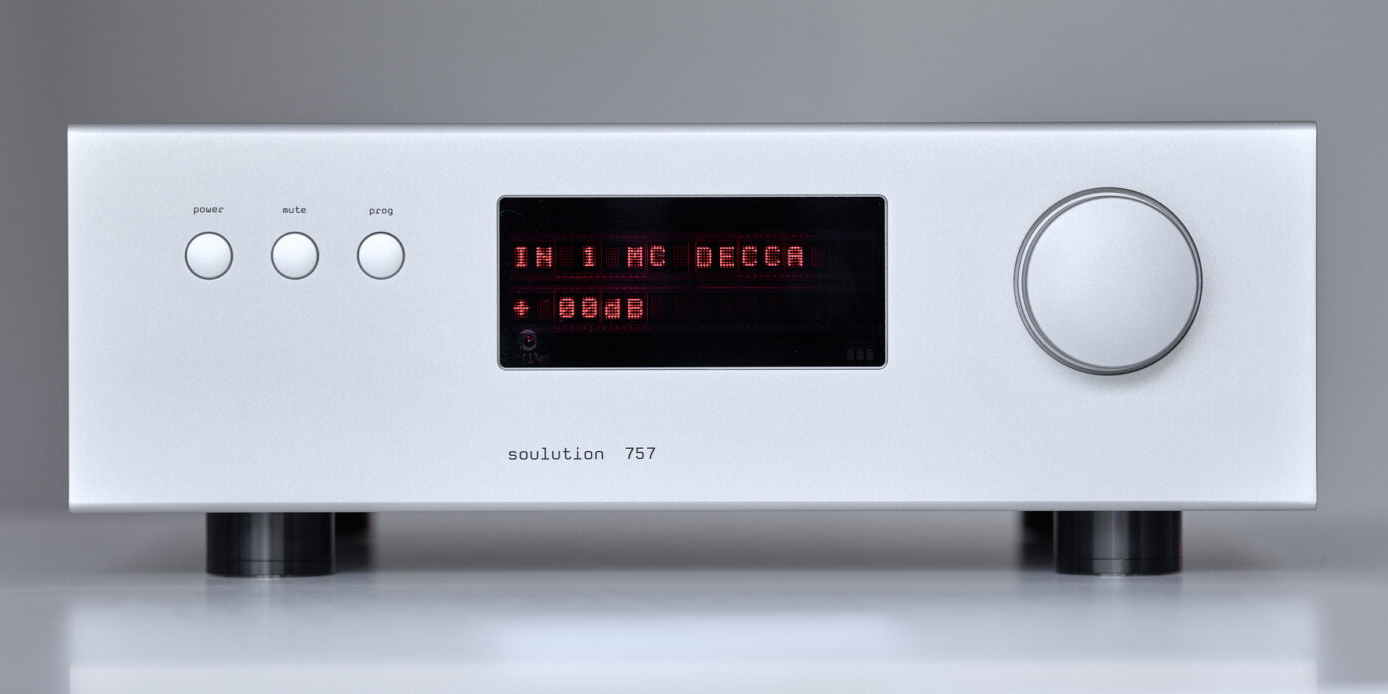
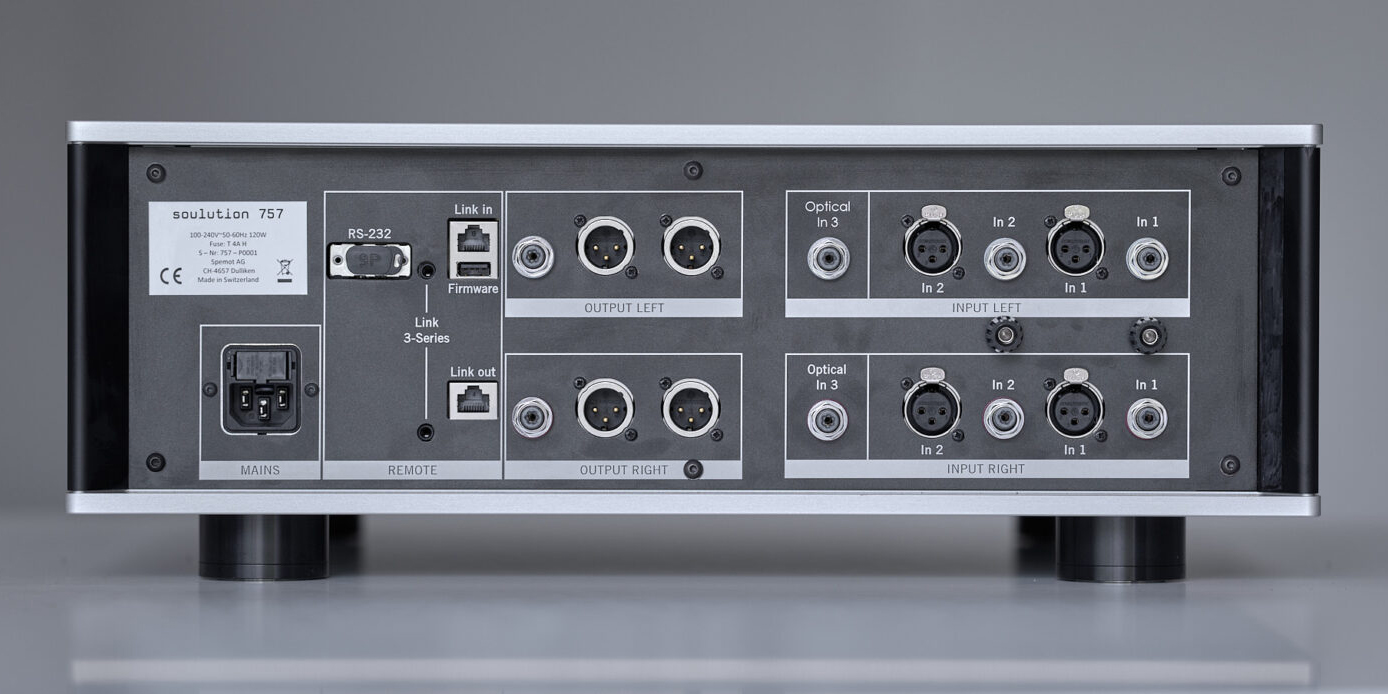
Wejścia 2 × MC, MM lub głowica taśmowa (RCA i XLR); 1 × DS audio optyczne (RCA)
Impedancja wejściowa MC: 10 Ω – 1000 Ω; MM: 47 kΩ i 0 – 750 pF; Głowica taśmowa: 20 kΩ - 100 kΩ i 0 – 750 pF
Dokładność deakcentacji (20 Hz – 200 kHz) ±0,05 dB
Pasmo przenoszenia (– 3 dB do deakcentacji) 0 – 2 MHz
THD niemierzalne
Szum punktowy (związany z wejściem) < -170 dBV/√Hz
Współczynnik tłumienia sygnałów wspólnych (CMRR) >100 dB
Separacja kanałów >100 dB
Wzmocnienie (maks.) -40 dB do +80 dB dla MC; -40 dB do +60 dB dla MM; -40 dB do +70 dB dla taśmy; -40 dB do +120 dB dla optycznego
Wyjścia 2 × zbalansowane (XLR); 1 × niezbalansowane (RCA)
Impedancja wyjściowa 0,8 Ω zbalansowane (XLR); 0,4 Ω niezbalansowane (RCA)
Napięcie wyjściowe maks. 16 Vpp zbalansowane (XLR); 8 Vpp niezbalansowane (RCA)
Prąd wyjściowy maks. 0,5 A
Wymiary (szer. x wys. x gł.) 480 × 167 × 450 mm
Waga ok 30 kg
LINK (zdalne włączanie) Sygnał sterujący 12 V
Soulution 757
Recenzje
Recenzja Soulution 757 w The Absolute Sound
As a long-time analog fan, I’ve listened to a great many phonostages in my life, several of them (like the 755) quite wonderful sounding. But I’ve never heard a phono preamp that betters this one. Its astonishing holism simply makes it more lifelike than its competition on all sources, and its versatility is currently unmatched by any other unit I’m familiar with. There is a reason why we gave the Soulution 757 de-emphasis preamplifier our highest honor—the 2025 Overall Product of the Year award. Those of you who swear by analog sources won’t find its like (or its better) anywhere else.
As reviewers and readers, we find it convenient to break things down into categories (i.e., detail, timbre, dynamics, durations, soundstaging, imaging, etc.), as if such things existed independently of one another. But the truth is that a collection of parts is not what we hear in real-life musicmaking. The parts are there, of course, and can be assessed on their own if we make a conscious effort to separate them out by ear. But what we actually hear is the way such parts integrate into wholes, within the resounding confines of a hall, studio, or club. It is this very integration—this sense of holism, of parts that are so intimately interconnected they don’t exist independently and of the wholes they constitute being greater than the sum of these parts—that the Soulution 727 and 757 are so exceptionally good at reproducing. Soulution puts a premium on preserving phase accuracy.
It is the prime rationale for the unparalleled bandwidth (20MHz, –3dB) of the 727’s and 757’s output stages. Phase shifts have almost exactly the same effect on sounds that out-of-parallax images have on optics. Eliminating either reduces blur, increases density of color, expands dynamic range, and cements into place the shape, body, detail, and location of subjects, on their own and vis-à-vis each other and their environs. What this exceptional phase accuracy results in with the 757 is sonic images of vocalists and instrumentalists that are so dense in timbre, so natural in duration, so supple in dynamic, so finely integrated in resolution, and so three-dimensional in presence that, on great recordings or tapes, you can almost visualize them. It’s as if you switched from a 2k LED TV to a 4k OLED panel.
At the risk of sounding like a typical reviewer again, let me say something more about the 757’s low bass, top treble, and midrange. Where the low bass of the Grand Master EQ unit allows for a larger number of roll-off options, it is, regardless of which eq you choose, very slightly less smooth, tight, dynamic, deep-reaching, and clearly defined in the bottom octaves than the Soulution 757. (This outstanding low-end grip is apparent on all sources—and is typical of Soulution preamps and amps.) On LP, Norman Keenan’s bass fiddle, for example, has never before sounded so fixed in space (at the back of the stage), so clearly individuated, so dense in timbre and precise and unruffled in pitch as it does through the Grand Maser EX optical cartridge and the 757’s optical input/output.
Part of this increase in clarity and realism has to do with the way the 757 images. Like the 727 linestage, the 757 de-emphasis unit condenses instrumental images. By this, I don’t mean it miniaturizes them; it simply focuses them with cleaner outlines, greater body, increased color and texture, and superior rootedness in space. It leaves you in no doubt where instruments are located on the stage vis-a-vis the microphones, the venue walls, and the other instruments playing alongside them, even in large ensembles like Basie’s band.
The 757 has the same effects in the top end. While not sounding overtly rolledoff, the 757 (with the Grand Master EX oc) has a simply phenomenal way of smoothing down treble “roughness” (caused, perhaps, by bumpy little phase shifts). As a result, the top octaves of Basie’s piano lose the occasional bit of glare they seem to develop with other phonostages on fortissimos, making them sound more continuously “of a piece” with the timbre of the piano’s lower octaves. Ditto in the midband with The Voice’s voice. Sinatra was 50 years old when this album was taped in the Copa Room of The Sands. Fifty years is a lot of cigarettes and a lot of Jack Daniels. His baritone, though completely under control, no longer has the youthful range and buoyancy of the Bobby Soxer Sinatra. It has aged, like bourbon in charred oak barrels. And with the 757, you hear this aging and the undiminished energy and mature expressiveness of his delivery not as if they were isolate high-fidelity parts but as if they were coming from a nearly visible whole, from Frank Sinatra at 50.
I greatly enjoyed my time spent experiencing the 757 tape replay and mc duties. Its direct tape head deemphasis capability is unique for a product that includes an mc/mm phonostage and optical cartridge equalization. The 757’s multi-input, multi-analog source (phonostage, tape repro, and optical cartridge EQ) playback potential can serve as the hub for the three-headed analog-sourced system. If Soulution’s 757 is not the analog source de-emphasis version of a “Swiss Army knife,” I don’t know what is.
Link do recenzji: Soulution 757 – The Absolute Sound
Soulution 757
Nagrody
Soulution 757 – The Absolute Sound – Golden Ear 2024

Soulution 757 – The Absolute Sound – Overall Product of the Year 2025

Link: Soulution 757 – The Absolute Sound – Overall Product of the Year 2025
Soulution 757
Galeria
Zobacz także

Soulution
Cennik
Cennik Soulution
Link: Cennik Soulution
Soulution
Dealerzy
Dealerzy Soulution
Link: Dealerzy Soulution