
Soulution 727
Dane techniczne
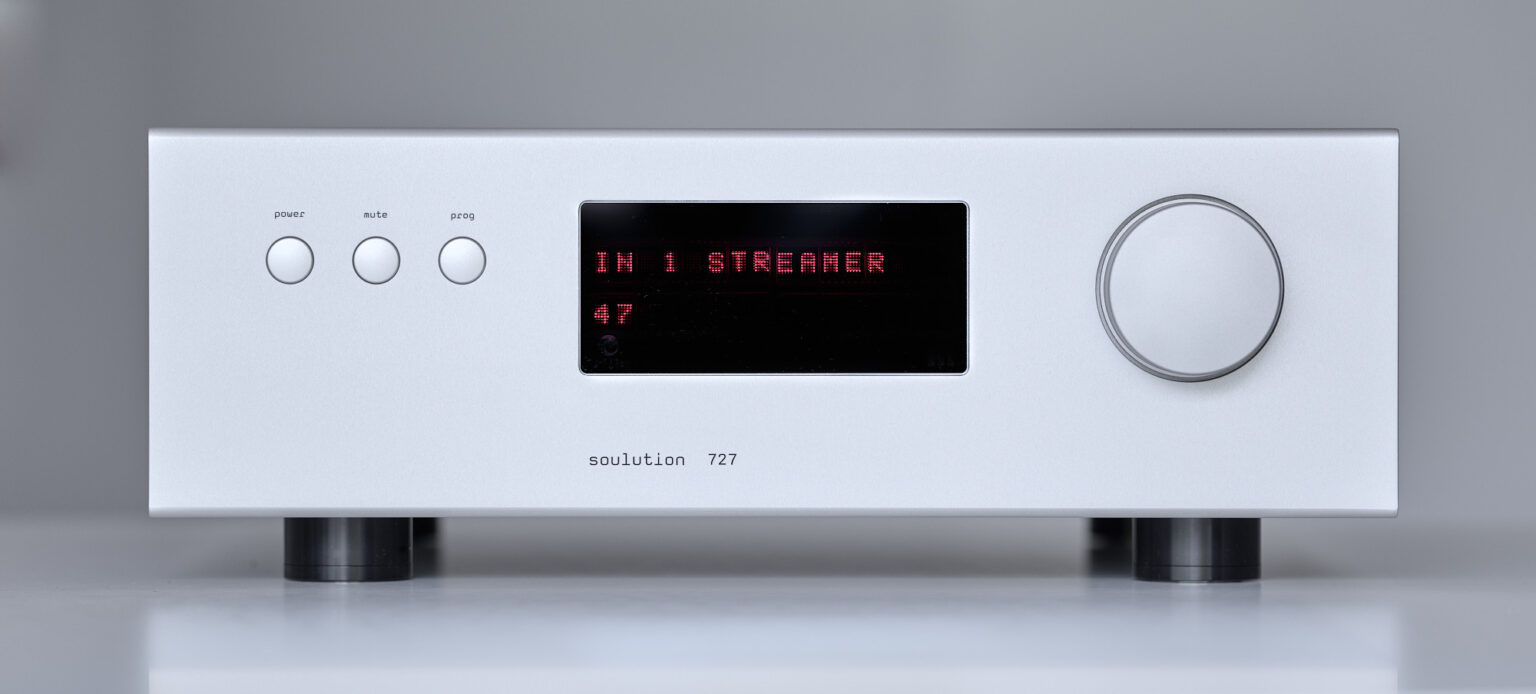
Zasilanie 220 – 240 V (50 – 60 Hz); 100 – 120 V (50 – 60 Hz)
Pobór mocy < 1 W w trybie czuwania, 60 W podczas pracy urządzenia
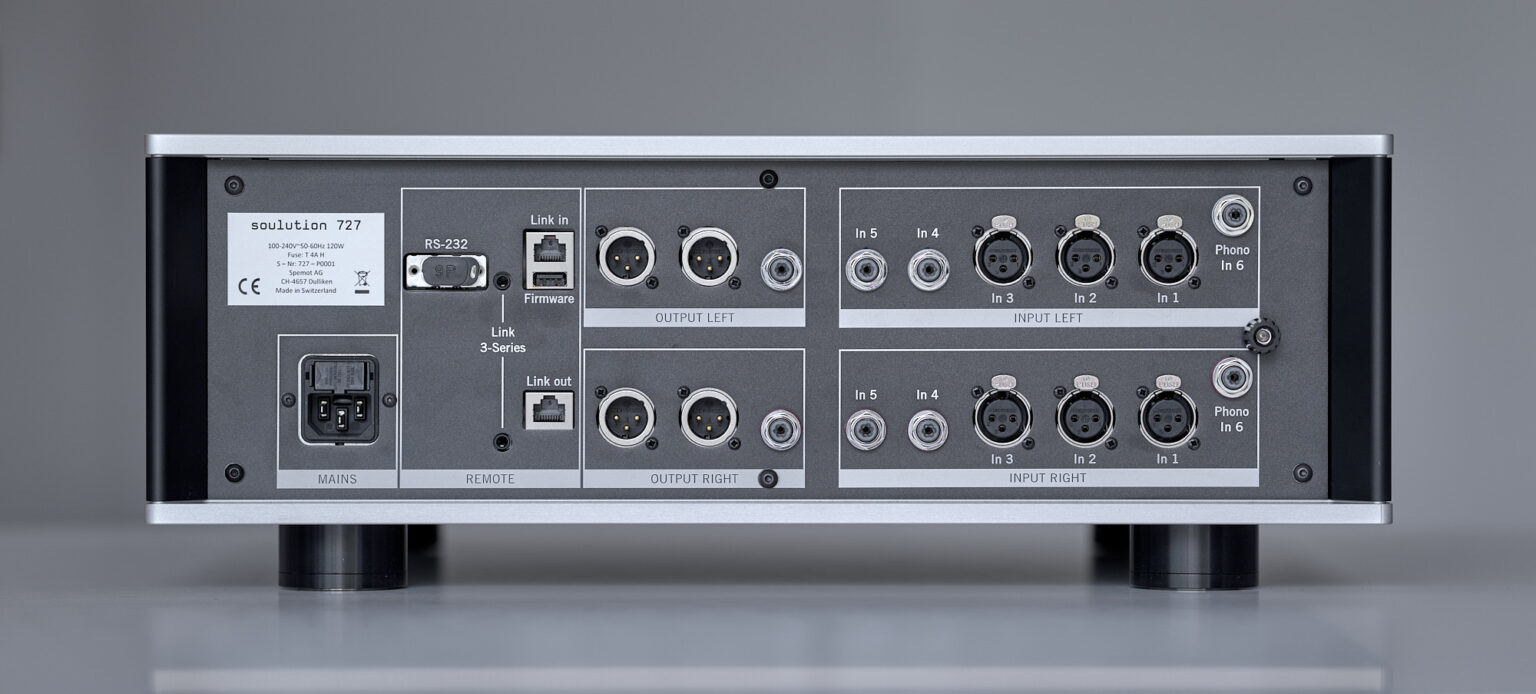
Wejścia 3 × zbalansowane (XLR); 2 × niezbalansowane (RCA); 1 × Phono (opcjonalnie)
Impedancja wejściowa 4,4 MΩ zbalansowana (XLR); 4,4 MΩ niezbalansowana (RCA); 10 – 1000 Ω lub 47 kΩ phono (regulowana)
Napięcie wejściowe maks. 9 Vpp
Wyjścia 2 × zbalansowane (XLR); 1 × niezbalansowane (RCA)
Impedancja wyjściowa 0,8 Ω zbalansowana (XLR); 0,4 Ω niezbalansowana (RCA)
Napięcie wyjściowe maks. 14 Vpp zbalansowane (XLR); 7 Vpp niezbalansowane (RCA)
Prąd wyjściowy maks. 0,5 A ograniczony przez obwód zabezpieczający
Pasmo przenoszenia (– 3 dB) DC – 20 MHz
Przesunięcie fazowe (@20 kHz) < 0,2°
Stosunek sygnału do szumu (20 Hz – 20 kHz @1 Vrms) >120 dB
Gęstość szumu (w odniesieniu do wejścia) < -160 dBV/sqrt(Hz)
THD+N <-120 dB
Współczynnik tłumienia sygnałów wspólnych >105 dB
Separacja kanałów >130 dB
Wzmocnienie +4 dB zbalansowane (XLR); -2 dB niezbalansowane (RCA); +44 dB do +84 dB (phono)
Gama regulacji głośności 0 do – 79 dB w krokach co 1 dB
Wymiary (szer. x wys. x gł.) 480 mm x 167 mm x 450 mm
Waga 28 kg
Soulution 727
Recenzje
Recenzja Soulution 727 w The Absolute Sound
To my ear, the 727 also has higher definition than the 725 (or 720). Focus is tighter and more concentrated with individual instruments and vocalists, while the stage remains vast (on recordings with vast stages), and three-dimensionally tube-like body and presence are enhanced. This tightened focus produces clearer delineation and greater “isolation” of instrumentalists within large or small groups vis-à-vis each other and the acoustic space around them, which may simply be a confirmation of Hammer’s claims “of more air around instruments and performers.”
This ability to more completely define the nexus of instrument, instrumentalist, recording space, and engineering is, without doubt, a step forward for Soulution and a confirmation of the “higher resolution combined with more lifelike musicality” that Hammer claims for his new preamp. It is also a nifty technological accomplishment. In my experience, increased speed and resolution, greater extension and clarity in the treble, and tighter overall image focus are generally accompanied by a reduction in density of timbre (i.e., a leaning down of tone color as in the original 720) and an accentuation of the starting transient phase of the dynamic/harmonic envelope—e.g., a move toward a quicker, more minutely detailed “fidelity to sources” balance. In this instance, that is not the case.
Oh, the minutiae and the speed are there, all right. In abundance. Just give a listen to Hans Theessink’s Jedermann Remixed: The Soundtrack [Blue Groove] on stream or (preferably) disc. The detailing of Theessink’s masterful guitar work—the sweet portamento-like glissandos of the slide and the sharp staccato-like pluck of the fingerpicks—is so sensationally realistic that one can effortlessly visualize the artist and the instrument at play. Not just one or the other—instrument or performer—but both in combination making music (in this case, in an ORF studio through what appear to be closely situated AKG condenser and dynamic mics).
Recorded live at The Pantages Theater in December 1983, Stop Making Sense has always been a special treat. How the band managed to perform such complexly scored and staged music live is still a wonderment, made even more wondrous through the Soulution 727 (and 757 and 711). All those myriad little musical crosscurrents you thought you were hearing back in 1984 are now plainly revealed. It’s really a kind of magic to be able to effortlessly follow Tina Weymouth’s bass ostinatos, Bernie Worrell’s keyboard fills, Jerry Harrison’s guitar riffs, Chris Frantz’s kickdrum, toms, and crash cymbals, Lynn Mabry, Ednah Holt, Alex Weir, Jerry Harrison, and Frantz and Weymouth’s backup vocals (on “Once In A Lifetime,” the ensemble stretches from stage left to right in the mid-distance, with almost every voice distinct) in fullest color and dimensions, while David Byrne, also in full color and three dimensions, does his incomparable thing (right down to sign language and Big Suits) at centerstage. It’s not just a sonic feast—it’s a near-visual, emotional, and intellectual thrill ride. To hear the way the 727 and 757 distinguish Weymouth’s Fender Jazz bass lines from the ongoing patter and 40Hz pedal-and-beater thump of Chris Frantz’s Rogers toms and kickdrum and the swooping aerial dives of Bernie Worrell’s Prophet 5 synth and Minimoog is to hear richly patterned music made from what were once less distinctly and fully characterized sounds.
Final thoughts? This is the most “complete,” the most lifelike preamp I’ve heard, fully living up to the sonic claims of its designer. Its ability to unearth musical and performance detail, correct “parallax”-like distortion, smoothly though not aggressively extend bandwidth, and better delineate sonic images without upsetting the timbral applecart or sacrificing a jot of three-dimensional body is quite an engineering feat. In fact, as noted, adding this much lifelike musical detail without steering, even slightly, toward the shoals of the analytical is a unique accomplishment in my experience. Naturally, the 727 gets my highest recommendation. The folks at TAS editorial agreed, naming it Solid-State Preamplifier of the Year (see page 62). It is an honor that is well deserved; this is a landmark design.
Link do recenzji: Soulution 727 – The Absolute Sound
Recenzja Soulution 727 w Stereophile
I didn't begin my audition with jazz tracks, however. Instead, I chose a recording I immediately decided to review: Kristian Bezuidenhout's performance, on a historically authentic fortepiano from 1805, of Mozart's Piano Concertos Nos.19 & 23 (24/96 WAV download, Harmonia Mundi), accompanied by the period instruments of the Freiburger Barockorchester. Through the Accuphase A-300s and the Soulution 727, the midrange sounded gorgeous and the highs alive but not too bright. The unique sound world of period instruments came through gloriously. I especially savored how the fortepiano sounded distinctly more percussive than a modern Steinway, with a more pointed, less sustained sound that showcased its harpsichord-like sparkle.
Beyond that lay the feelings inspired by the notes. I cannot begin to convey how delightful the opening movement sounded—how happy it made me feel—and how well the Soulution 727 transmitted the unique tang, more distinct leading edge, peacock-worthy color display of period instruments. I was in heaven, and I also marveled at how perfectly the orchestra followed Bezuidenhout's lead, and how well the preamp enabled me to hear the orchestra's ability to mirror its leader's phrasing. By recording's end, I knew that the Soulution 727's truth-telling veracity—its truth to the source—was something to cheer about.
Wishing to dwell longer in period instrument paradise, I turned to Ernst Schlader's marvelous performance, on a superbly voiced copy of an historically appropriate basset clarinet, of Mozart's Clarinet Concerto. Schlader's virtuosity, on the Pentatone recording of Mozart: Symphonies 29 & 33 Clarinet Concerto (24/96 FLAC download, Qobuz), is enhanced by the colorful period instruments of Akademie für Alte Musik Berlin, led by concertmaster Bernhard Forck.
What I loved most was the unforced, natural, unadorned sound of every instrument. "It sounds beautiful as hell," I wrote in my notes. "Forget about playing the first three minutes; I'm listening to the whole damn thing, deadline be damned. I can't believe I'm being paid to do this."
At that point, I called a halt to my mental chatter and proceeded to audition all the other recordings on Hammer's list. On the Helge Lien Trio's "Gamut Warning" from Hello Troll (24/96 FLAC, Ozell/Qobuz), cymbals were perfection itself. True to expectations, bass was totally in control and impressively deep. But there was something more. It's rare that any system has enabled me to feel the visceral impact of plucked strings as they vibrate against the neck of the double bass, but the Soulution 727, with more than a little help from the trio's sound engineer, made that possible. Score one in the gobsmacked department.
The Soulution 727 preamplifier is one of the finest-sounding components I've heard in my system. Its bottom line is unadorned honesty. Timbres are absolutely, incontrovertibly, certifiably 100% natural, uncolored, and true-to-the-source. In addition, control is impeccable from the deepest bass to the most stratospheric highs, and timing is excellent.
If I weren't a reviewer whose responsibilities require that I parse for fine differences, I wouldn't have thought an iota about all that PRaT stuff (footnote 8). Instead, I would have felt as I did the first time I heard the Soulution 727 in my system: This preamp really has no sound of its own. Rather than impose a distinct sonic signature, it gets out of the way of artists and engineers and lets music and the emotional truth it conveys speak for itself. The Soulution 727 deserves Stereophile's highest possible recommendation.
Link do recenzji: Soulution 727 – Stereophile
Recenzja Soulution 727 w Hifi.nl
Het systeem rondom de 727 verplaatst je naar hogere en aantrekkelijke dimensies. De 3D-weergave zorgt wederom voor luisterplezier tijdens het draaien van The Moon Represents My Heart van Teresa Teng. Deze, in China, enorm populaire song laat het slagwerk helemaal rechts naast de luisterplaats horen en andere subtiele geluiden ver links naast de luisterpositie en linksboven. De soundstage vormt dus een boog om de luisteraar.
Binnen die stage is een enorme definitie. Het geluid is plastisch en grijpbaar op een natuurlijke manier. Het is opvallend dat gefocusseerde geluiden binnen de stage geïntegreerd zijn met de rest. Geluid kan naar voren komen, zoals bijvoorbeeld een trompetsolo, maar het blijft verbonden met de rest van het muzikale gebeuren. Zo’n ongelofelijk fraai en samenhangend plaatje wordt neergezet tijdens het draaien van The Saga of Harrison Crabfeathers van Brian Bromberg. Die track, die een indrukwekkende muur van geluid presenteert en zeer spectaculair overkomt, leert ook de zeer goed gedefinieerde en krachtige laagweergave van de 727 kennen. De bas klinkt weergaloos. Het is wat Cyrill Hammer realisme noemt. Daaraan levert de 727 een fundamentele bijdrage, maar het ontstaan van realisme komt vaak vanwege een ideale combinatie tussen de bron, de versterking, de luidsprekers en de opname. Alle drie de systemen vormen een supermatch en spelen, samen met de 727, op een zeer hoog niveau.
Er zijn talloze tracks beluisterd. Uiteindelijk klinkt het enorm gaaf. Het geluid heeft een enorme transparantie en doorzicht. Er is geen greintje scherpte en er heerst een enorme rust. Alle muziek krijgt een extra dimensie. Draai Let’s Get Loud van Jennifer Lopez, Shallow van Lady Gaga, Aint’No Sunshine van Buddy Guy en Tracy Chapman of Long van Carla Bley en er staat een contrastrijk en natuurlijk geluidsbeeld. Muziek luisteren doe je met een heel systeem. De 727 levert daarin een bijdrage. Met de juiste match kun je goede eigenschappen van een bron, voorversterker en luidsprekers nog beter accentueren. Er ontstaat dan synergie. Twee van de beluisterde systemen waren actief. Actieve luidsprekers bereiken vaak een hoger niveau van realisme. De 727 komt in zo’n systeem zeer goed tot uiting. Een medeluisteraar met een voorliefde voor jazz merkte op dat hij, vanwege het niveau van weergave, ook klassiek en pop zou kunnen gaan waarderen.
Een collega, die schrijft in Amerikaanse en Engelse publicaties duidde recent iets waar ondergetekende ook mee bezig is. Dat we met veel hifi-systemen enorm afgedwaald zijn van livegeluid. De barre essentie van geluidsapparatuur is dat je zo dicht mogelijk bij livemuziek komt. Consumenten hebben vrijwel nooit een referentie naar live. Ze refereren naar een audio-apparaat of naar een kabeltje. De marketing treft hierin blaam. Daarin is het altijd de vraag hoe je iets kunt maken dat als een slagroomtaart in de bek van de consument past. Iets moet verkoopbaar zijn, ook als je het hele universum daarvoor moet verloochenen.
Toch kun je de consument ook opvoeden. Leren hoe akoestische livemuziek echt klinkt en producten en opnames maken die daar in de buurt komen. De Soulution 727 draagt daar ongetwijfeld aan bij. Tijdens de luistersessies met de drie systemen en goed bronmateriaal waren er momenten die ijzingwekkend dicht bij een livebeleving kwamen. Meer realisme en minder hifi.
Het is mogelijk om een relatie te leggen tussen de gebruikte techniek in de 727 en de prestaties. Er zijn zeer slimme technische oplossingen gekozen. Dat leidt tot evolutionaire verbeteringen. Bedrijven als Soulution balanceren op de grens van wat technisch mogelijk is. Laat het duidelijk zijn dat er vrijwel geen enkel audiocomponent is dat alles op topniveau goed doet. Het uitgangspunt is altijd de set die je bouwt. Daarin compenseer je door de keuze van de individuele apparaten.
Het eindresultaat is dan dat je je geluidsmatige doelstellingen bereikt. Dat vergt heel veel ervaring en staat loodrecht op hoe veel consumenten denken. Die gaan uit van individuele componenten, maar je moet op het niveau van de systeemsynergie denken met levensecht geluid als doel. De 727 heeft voor een enorme verrassing gezorgd. Het voegt echt toe aan de beleving en er is nachtenlang met immens plezier naar muziek geluisterd. Meer live en meer betrokkenheid. Dat maakt iets los en vraagt om zelfbeheersing. Nu op zoek naar een sponsor. Die kent u vast. Zo’n altruïstisch, aardig, op andermans welzijn gericht persoon die audiofiele doelen faciliteert.
Link do recenzji: Soulution 727 – Hifi.nl
Soulution 727
Nagrody
Soulution 727 – Stereophile – Recommended Components 2025

JVS loved what he heard, commenting that the midrange sounded gorgeous, the highs alive but not too bright, control was impeccable from the deepest bass to the most stratospheric highs, and timing was excellent. "This preamp really has no sound of its own. Rather than impose a distinct sonic signature, it gets out of the way of artists and engineers and lets music and the emotional truth it conveys speak for itself," concluded JVS, adding that the Soulution 727 deserved Stereophile's highest possible recommendation. When JA measured the Soulution 727 he commented that it was the quietest preamplifier he had encountered. Overall, with both its line and phono inputs, the 727's measured performance was superb, with extraordinarily low distortion and noise.
Link: Soulution 727 – Stereophile – Recommended Components 2025
Soulution 727 – The Absolute Sound – Golden Ear 2024

Soulution 727 – Stereophile – Recommended Components 2025

JVS loved what he heard, commenting that the midrange sounded gorgeous, the highs alive but not too bright, control was impeccable from the deepest bass to the most stratospheric highs, and timing was excellent. "This preamp really has no sound of its own. Rather than impose a distinct sonic signature, it gets out of the way of artists and engineers and lets music and the emotional truth it conveys speak for itself," concluded JVS, adding that the Soulution 727 deserved Stereophile's highest possible recommendation. When JA measured the Soulution 727 he commented that it was the quietest preamplifier he had encountered. Overall, with both its line and phono inputs, the 727's measured performance was superb, with extraordinarily low distortion and noise.
Link: Soulution 727 – Stereophile – Recommended Components 2025
Soulution 727
Galeria
Zobacz także

Soulution
Cennik
Cennik Soulution
Link: Cennik Soulution
Soulution
Dealerzy
Dealerzy Soulution
Link: Dealerzy Soulution