
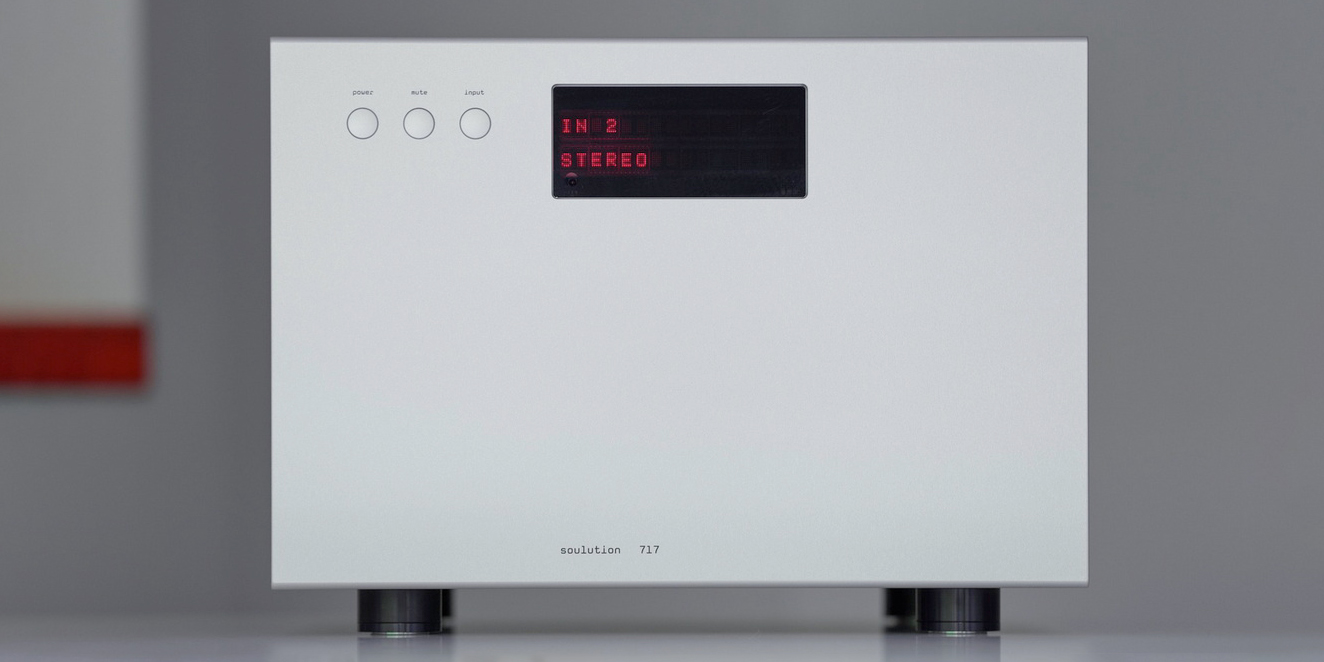
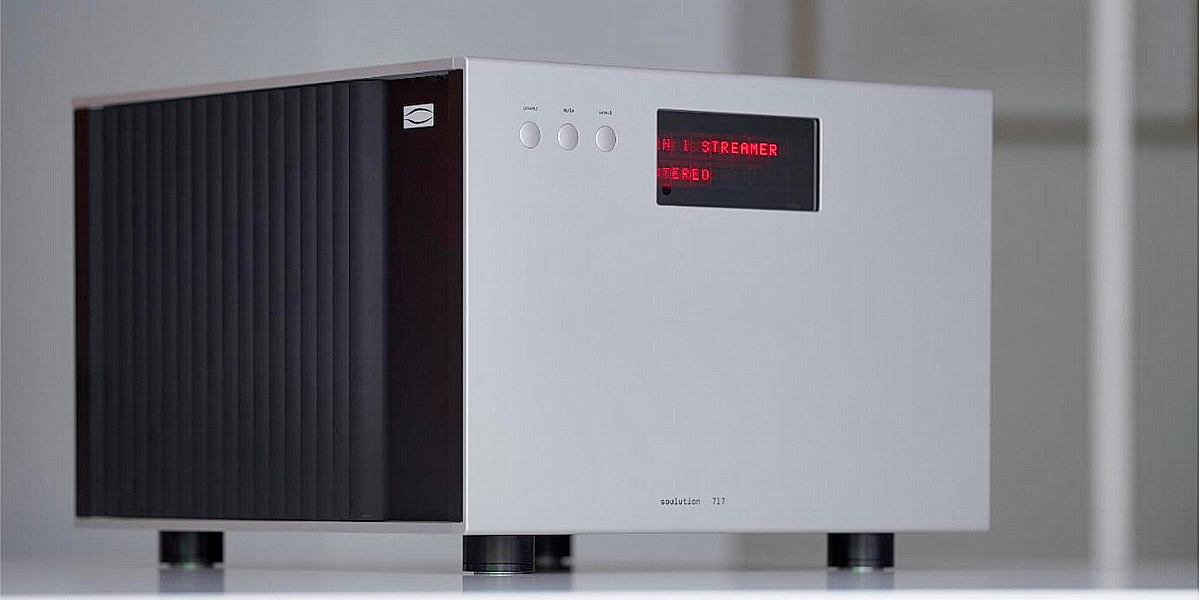
Soulution 717
Dane techniczne
Zasilanie 100– 240 V (50 – 60 Hz)
Pobór mocy < 0,5 W w trybie czuwania bez obciążenia 300 W maks. 1600 W
Wyjścia 2 pary zacisków miedzianych, pozłacanych
Wzmocnienie + 26 dB
Moc wyjściowa 2 × 150 W przy 8 Ω; 2 × 300 W przy 4 Ω; 2 × 600 W przy 2 Ω
Moc impulsowa > 2 × 6000 W
Pasmo przenoszenia (– 3 dB) 0 – 2 MHz
Rożnica fazowa (przy 20 kHz) < 0,2°
THD + N < 0,001% przy 50 W przy 4 Ω (20 Hz – 20 kHz)
Stosunek sygnału do szumu 108 dB (5 W przy 1 kHz)
Szum punktowy (związany z wejściem) < 165 dBV/sqrt(Hz), 20 Hz – 20 kHz
Separacja kanałów > 120 dB przy 1 kHz
Współczynnik tłumienia > 10 000
Prąd wyjściowy maks. 32 A (ograniczony)
Wejścia 2 × symetryczne (XLR)
Impedancja wejściowa 4,4 MΩ symetryczna
Wymiary (szer. x wys. x gł.) 480 × 350 × 505 mm
Waga ok 50 kg
LINK (zdalne włączanie) sygnał sterujący 12 V
Soulution 717
Recenzje
Recenzja Soulution 717 w Highfidelity
Z oceną nie mam kłopotów, to jest odlot, stratosfera, kosmos.
Na moich oczach dokonał się bowiem postęp i to postęp naprawdę duży. „717” jest jednym z najlepszych wzmacniaczy jakie znam, czyli – dopowiem – jednym z najlepszych, moim zdaniem, wzmacniaczy na Ziemi.
Jego brzmienie jest wręcz modelowo podobne do tego, co oferują małe, 8-watowe wzmacniacze z lampami 300B, jeśli chodzi o rozdzielczość, szybkość i transfer energii. Ale to też brzmienie mocnego Kondo Ongaku z jego nasyceniem i „bajeranctwem”. I jeszcze na basie doskonałych wzmacniaczy tranzystorowych, na przykład → YPSILON HYPERION. To coś w rodzaju miksu tych umiejętności plus coś ekstra, to jest absolutna swoboda w przekazywaniu nawet największych założeń i najbardziej skomplikowanych pasaży.
Jest więc jedwabista, gładka, złocista góra, która jest jednak doskonale czytelna i różnicowana barwowo, dynamicznie oraz przestrzennie. Jest też bardzo, bardzo niski bas z doskonałą fakturą i kontrolą, ale nigdy nie jest on „kwadratowy”, ani też przesadnie konturowy (rozumiem przez to nadmiar ataku, a niedomiar wypełnienia). Ale jest przede wszystkim środek pasma, to on jest tu najważniejszy i to on jest tu najpiękniejszy.
Ta, właśnie to wzmacniacz robi doskonale: kreuje światy. Właściwie to re-kreuje, ale robi to tak dobrze, że można mu nadać prawo do ich nazwania, do pokazania w jemu właściwy sposób. Czyli podobnie jak wzmacniacz 300B, z jego piękną średnicą, ale z szerokim pasmem i niebywałym wolumenem dźwięku.
Jak każdy produkt, tak i „717” ma swój własny dźwięk Innymi słowy brzmienie o cechach, które da się opisać i skonfrontować z innymi produktami. Co najlepiej wyjdzie, kiedy go porównamy z modelem „710”. Dla obserwatora zewnętrznego, czyli takiego, który nie zna systemów tej klasy lub nie zna Soulution, różnice między nimi mogą się wydać mniej ważne od samego dźwięku, jaki prezentują. A ten jest, moim zdaniem topowy, to szczyt tego, co współczesne audio ma do zaoferowania.
To jest bowiem, tak to widzę, w pewien sposób „lampowe” brzmienie. Lampowe bardziej w stylu → KONDO ONGAKU niż → ANCIENT AUDIO SILVER GRAND MONO II, raczej urządzeń Dana D’Agostino niż Naima, lamp EL34, a nie KT120. Wiem, wiem – na wystawach tak tego nie słychać, systemy z Soulution grają raczej wyraźnie, czasem jasno. Ale to przypadek podobny do topowych Harbethów – one również na wystawach brzmią lekko. A przecież każdy, kto je słyszał u mnie wie, że to potęga basu i mocnego, niskiego środka. W podobny sposób odbieram wzmacniacz o którym mówimy.
Ta „lampowość” przejawiałaby się w jedwabistości i nasyceniu środka pasma. Kiedy słucham FRANKA SINATRY z Sinatra Sings Gershwin, szczególnie w ˻ 2 ˺ I’ve Got a Crush on You czy ˻ 4 ˺ Someone To Watch Over Me, to doskonale słyszę wibrato w jego głosie, nie da się nie zauważyć perfekcjonizmu Błękitnookiego w wykańczaniu fraz, w dykcji. Soulution 717 pokazuje to w miękki sposób, w sposób przyjazny, ale też ultraprecyzyjny.
Link do recenzji: Soulution 717 – Highfidelity
Recenzja Soulution 717 w The Absolute Sound
The first thing I listened to (through the 727 linestage, the 757 de-emphasis preamp, and two 717s operating as monoblocks in bi-amp mode) was an old-favorite cut of vinyl, Dean Martin’s “I’m Confessin’” from Acoustic Sound’s celebrated 45rpm remastering of Dream with Dean. While this LP has always sounded great regardless of ancillary gear, this time around it sounded magical. No, Dean didn’t have quite the same in-the-room-with you presence he had with ARC’s marvelous tubed REF 330Ms, but his voice was considerably more three-dimensional than I’d heard it sound in the past through solid-state amplifiers, Class A or AB. The 717’s imaging was life-sized (not reduced) and softly rounded, as in bas-relief, and its tone color was extremely voluptuous, darker and richer than the ARC’s dead-center neutral presentation but just as lifelike and even more seductive. In fact, all the instruments—from Ken Lane’s piano to Barney Kessel’s guitar to Red Mitchell’s standup bass and Irv Cottler’s drum kit—were imaged with this same three-dimensionality and lifelike density of color, without any losses (in fact, with noticeable gains) in the continuousness that makes them sound less like independently recorded voices and more like a small jazz combo playing together in the same space at the same time.
Take Red Mitchell’s double bass, for example. On “I’m Confessin’,” his contributions were certainly clearer than they’d been in the past. But, importantly and unusually, they were also more musically complete. With the superb Vitus SM-103 Mk.II or the JMF HQS 7001 monoblocks (or Soulution’s 711, for that matter), plucked bass notes aren’t always fully “rounded off” at the finish, the way they are in life. Typically, you hear the transient pluck, followed by the pitch, timbre, and intensity of the sounded note, and then, usually, a slightly amorphous decay. It’s as if the fabric of the dynamic/harmonic envelope were frayed at its trailing edge, like the fringe of a scarf or a shawl.
With the 717, this is not the case. The sound of the note finishes with the three-dimensional solidity of an ebony carving. Development and decay aren’t slightly curtailed or condensed. The duration of the dynamic/harmonic envelope is fully complete, as it is in life.
When I first heard this highly realistic effect, I was shocked. Truth is I’d never heard it quite as clearly before on a stereo system, even with Soulution gear, which was my reference standard for the bottom octaves. Such durational completeness is, in my experience, unique. Not only does it realistically (and literally) sustain the last of the development phase and the entire decay of a low bass note; it also adds lifelike body, temporal structure, and three dimensionality to the instrument that is sounding it. You hear the whole of the double bass—not just the strings and neck but also the upper, lower, and C bouts, the bridge, the soundpost, the bass bar, and the volume of wood-colored air inside the instrument—and you hear the contributions of these parts with correct timing, as the note starts, develops, and finishes at an uncannily natural pace.
Such remarkable durational accuracy and completeness aren’t confined to the low end. On something like Hans Theessink’s slide and acoustic guitars, mandolins, and mandocellos from my oft-played CD of Jedermann Remixed—The Soundtrack [Blue Groove], I noted something else I hadn’t heard so clearly before (if at all). Once again, these details didn’t stand out as if spotlit or isolated, but at the start of a note the transient sound of thumb and fingertips brushing the strings and during the development and decay phases the rather beautiful harmonics of the slide glissandos and fingerpicked melodies of Theessink’s instruments were suddenly there to be savored in their entirety, albeit at an appropriately reduced intensity, part and parcel of the sonic event. It made the instruments and instrumentalist seem ever so much more lifelike and “there.”
Link do recenzji: Soulution 717 – The Absolute Sound
Soulution 717
Nagrody
Soulution 717 – Highfidelity – GOLD Figerprint

Soulution 717
Galeria
Zobacz także

Soulution
Cennik
Cennik Soulution
Link: Cennik Soulution
Soulution
Dealerzy
Dealerzy Soulution
Link: Dealerzy Soulution