
Boulder 1162
Dane techniczne
Moc ciągła, 8 omów 300 W
Moc szczytowa, 8 omów 450 W
Moc szczytowa, 4 omy 900 W
Moc szczytowa, 2 omy 1000 W
THD, 8 omów 300 W 0,002%, 20 kHz: 0,01%
THD, 4 omy 300 W 0,002%, 20 kHz: 0,01%
THD, 2 omy 300 W 0,003%, 20 kHz: 0,02%
Równoważny szum wejściowy (EIN), 20 kHz, BW 2.2 μV
Odpowiedź amplitudowa, 20 Hz do 20 kHz +0,00, -0,04 dB
Pasmo przenoszenia, -3 dB 0,015 Hz, 150 kHz
Wzmocnienie napięcia 26 dB
Impedancja wejściowa 200 kΩ symetryczna 100 kΩ niesymetryczna
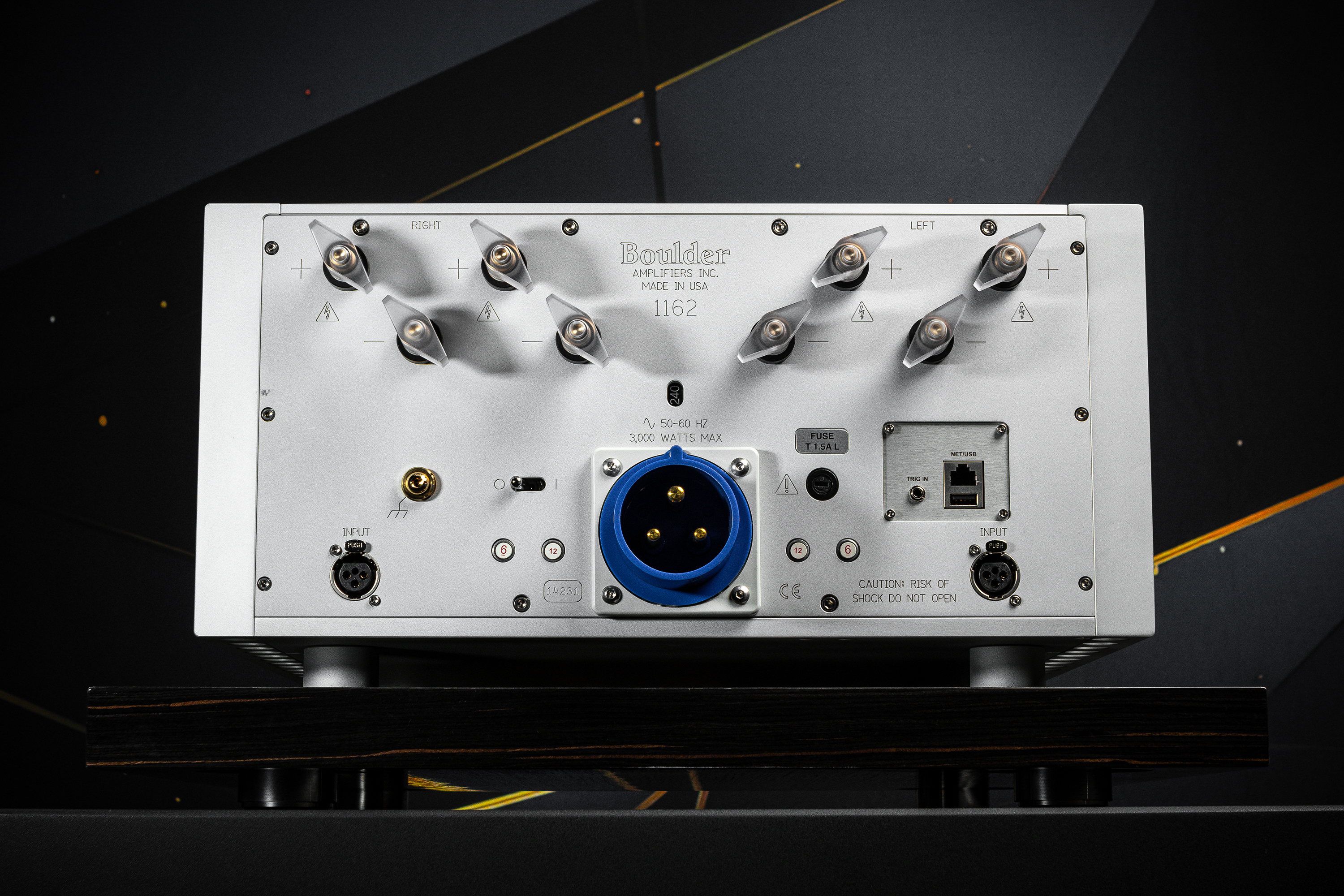
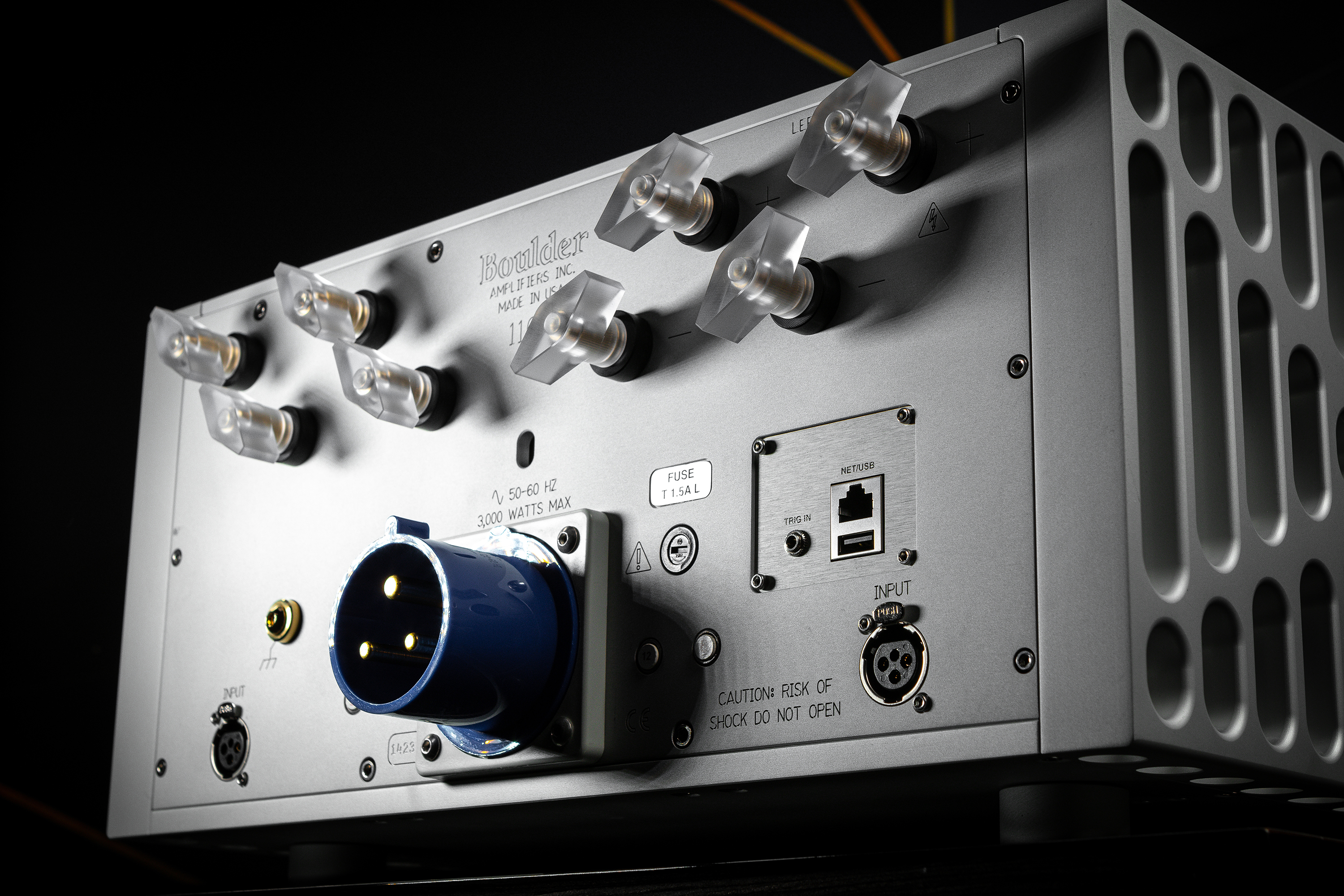
Wejścia Symetryczne 3-pinowe XLR
Wyjścia 6 mm zaciski mocujące
Wymagania dotyczące zasilania 100 V, 120 V, 240 V 50–60 Hz
Pobór mocy 10 W w trybie czuwania 120 W w stanie spoczynku
Waga 61,2 Kg
Boulder 1162
Recenzje
Recenzja Boulder 1162 w The Absolute Sound
The Boulder 1162 directly addresses the normal tradeoff between detail and beauty. It gives you loads of information about what is on the recording, while avoiding artifacts that reduce naturalness. The 1162 strikes the balance between musical insight and listenability as well as any amp I have heard.
I say this because the 1162 delivers so much sonic insight in the upper midrange and treble regions. And it does this without a sense of stridency or edge. It doesn’t blur the sound, it simply gives you detail without harshness on good recordings. Violins in particular are beautifully handled. The Paganini Caprices with Duenas on DGG is just a marvel with the 1162 because you hear all the detail, but not as exaggeration or edge. I had a similar result with the Bartok String Quartets with the Takacs Quartet on Decca. There, the viola and cello were especially rich and the violins were impressively easy to follow. I do think both of these recordings are brighter than you’d experience live, but this is common with close microphone placement. The attractive element of the 1162 is that it seems to give you what is on the recording so honestly that you feel more like you were present for the session even though the balance is different from what you’d hear in the hall.
The other element of voicing with the 1162 is its bass reproduction. Bass here is an interesting mix of detail and warmth. This is to say that some detail-oriented amps appear a bit threadbare in the bass, but that isn’t the case here. On Explosions in the Sky’s American Primeval, the bass has the intended subterranean depth without getting turgid or bloated. It might be best to say the 1162 has the so-called feeling of bass “grip” that is natural rather than an audiophile effect.
To help explain what you get with the 1162, it may help to say that it strikes me as a “transparency” and “dynamics” amplifier, while retaining a sense of tonal naturalness that doesn’t always go with those terms. On Annahstasia’s Tether, her voice has a “you are there” quality that is exceptional with the 1162. You get this effect when all the details are there, and aren’t blurred, and when nothing is exaggerated with overshoot or ringing. Then if you listen to the acoustic guitar on this recording, the body colors shine through with a realistic warmth.
As it happens, the 1162 does an excellent job with imaging. When the speakers and room and recordings allow it, the images are floated beautifully in space and nicely detached from the speakers. Front to back layering of images with the Boulder is very well done, at times startlingly so as with the Takacs recording I previously mentioned.
With this in mind, I like to try recordings from many eras. The 1162 did surprisingly well at this test. I usually assume that “transparency” amplifiers will come up short here, but not so, and the 1162 helped me see why.
The 1162 reveals what is on the recording, and while you might (I often do) disagree with production decisions, the low distortion of this amp simply lets you hear what is happening with lower-than-normal punishment. This approach can open up older music, which is often helpful. You can hear this wonderful music with less mud or sense of compression, a very big gain I think.
Link do recenzji: Boulder 1162 – The Absolute Sound
Recenzja Boulder 1162 w OHHIFI
The 1162 can drive any conceivable loudspeaker to any rational level with an unshakeable composure, never sounding strained or compressed.
This absolute authority is most apparent in the lower octaves. The bass is a study in control, retaining the speed, tightness, and powerful articulation for which the 1160 was lauded. Complex bass lines are rendered with stunning clarity, each note distinct and free of bloat or overhang. During a demonstration at an audio show, a system powered by the 1162 produced bass that was described as the kind "you feel pressing your chest," a testament to its visceral impact and control. This iron-fisted grip extends across the entire frequency spectrum, creating a vast and meticulously organized soundstage. As noted in the same show report, the 1162 helped craft a "tangible and fleshy" center image, with a soundfield that "extended beyond the front wall," echoing the broad, well-defined presentation of its forerunner.
Yet, this is where the 1162 departs from its ancestry and reveals its new, captivating soul. Layered upon this foundation of unflappable control is a newfound radiance, a quality directly attributable to the Smart Current output stage. Drawing from the sonic descriptions of the sibling 1151 monoblocks, the 1162’s presentation can only be described as "beautiful" and "gorgeous". There is an inner warmth and freshness to the sound, a vitality that transforms the listening experience from an analytical exercise into a deeply emotional one.
This transformation is most evident through the midrange and treble. Where the older Boulder sound was characterized by its stark neutrality, the 1162 presents instrumental and vocal textures with a palpable sense of body and harmonic richness. Pianos are rendered with a "radiant, glowing" quality, and voices are "marvelously illumined," floating free from a stunningly silent backdrop. This black background, a product of the heroic power supply shielding and meticulous grounding, allows the subtlest of micro-details and ambient cues to emerge with startling clarity, imbuing the music with a breathtaking sense of realism. The 1162 doesn't achieve its musicality by adding a euphonic coloration; rather, its near-perfect elimination of electronic artifacts allows it to reveal the natural warmth and texture inherent in the recording itself. It doesn't create beauty; it unveils it.
To fully appreciate the achievement of the 1162, it must be placed in context, primarily against its decorated predecessor, the 1160. The 1160 was, and remains, a phenomenal amplifier—a benchmark for analytical precision, transparency, and power. It delivered the unvarnished truth of a recording with forensic accuracy. The 1162 retains every ounce of that control and resolution but adds a crucial new dimension: emotional insight. The shift is not merely from good to better, but from a technically perfect photograph to a living, breathing work of art. The 1160 showed you every detail with unflinching honesty; the 1162 does the same, but also reveals the warmth of the wood, the intent of the artist, and the soul of the performance. This is a true generational leap, an internal revolution so complete that an 1160 cannot be upgraded to an 1162.
The central question was whether Boulder had managed to teach its titan to sing. The answer is an unequivocal and resounding yes. The innovative Smart Current technology has successfully bridged the gap between analytical precision and emotional connection, resulting in a sound that is at once breathtakingly real and deeply, movingly beautiful.
Link do recenzji: Boulder 1162 – OHHIFI
Boulder 1162
Nagrody
Boulder 1162
Galeria
Zobacz także

Boulder
Cennik
Cennik Boulder Amplifiers
Boulder
Dealerzy
Dealerzy Boulder Amplifiers